
High Brix Tea
A comprehensive, nourishing, organic, home-made
spray & drench to:
--Raise Brix (plant sap’s dissolved sugars & minerals indicating nutrient density)
--Repel pests & disease
--For seedlings, vegetables, flowers, fruits, trees
Typically, South Central Alaskan soils lack boron (B) and are low in calcium (Ca). These minerals are essential but deficient. The lack of B & Ca prohibits other minerals from fully functioning for plant growth & health. This home-made liquid addresses these deficiencies & make other minerals availabe.
Boron is tricky it’s needed in parts per million (ppm). A ppm is equivalent to 1 tsp in a conex shipping container volume. Boron above 2 parts per million is toxic. Below 0.8 ppm is a deficiency. So do not over-do. Don’t throw left-overs in the compost (or greatly dilute & spread it out).
Measurements 3 tsp = 1 Tbs. 4 Tbs = ¼ cup. 16 Tbs = cup 16 cups= 1 gallon
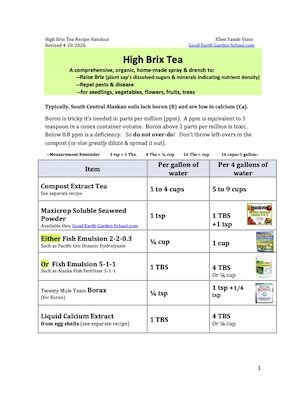
Use as a foliar or a drench application, or both at once.
Be sure to label and date everything!
Watch this short video of results.
~~~ If you follow this regimen, I would love to hear from you!~~~
--What do you observe? --What changes do you notice?
--What difficulties did you have?
--If there is a scientist in you, try half a row of crops with and half the row crop without. See what you observe.
--Ellen/Ellie VandeVisse, information@goodearthgardenschool.com